

What is the TEACCH Method

The method TEACCH is a holistic system of education, which is individualized to the needs of each child through the modification of the environment, with the aim of enhancing organization, understanding, reducing anxiety in transitions/changes and autonomy.
With this method the child manages to become more and more autonomous in the routines and obligations of everyday life (e.g. daily reading, weekly tasks, etc.), through the creation of a predictable and visually organized schedule.
Essentially, the method works on the idea that children on the autistic spectrum or with other developmental disorders function and learn best when there is clear structure and visual discrimination.
TEACCH, unlike ABA (Applied Behavior Analysis), does not work by modifying behavior through the use of reinforcers (e.g., “I'm quiet to get a sticker”), but by creating a supportive environment that reduces stress in transitions and facilitates understanding (“quiet position vs. work position”).
Also, unlike PECS (Picture Exchange Communication System), which focuses purely on communication through picture exchange, TEACCH uses visual aids as tools of educational strategy.
The concept of «structured teaching» is at the core of the method. It involves the organisation of the physical space, the clear separation of activities, the use of visual or other programmes and work systems that guide the child in the “what”, “when” and “how” to do something.
In this way, education becomes predictable and understandable, enhancing the child's autonomy.
Basic Principles and Elements of TEACCH
The basic principles of TEACCH are:
The physical structure of space : Each space is clearly arranged according to its function, so that the child recognizes what he or she is supposed to do there.
That is, the child in one position will do his work, in another his play, in another he will relax, etc.
The visual schedules (visual schedules), show the child which activities will be done and in what order, through visual stimuli.
In this way the child knows what will follow and does not have difficulty in transitions, becomes more and more independent and organizes both space and time.
The task boxes are boxes or work folders containing the appropriate materials, properly organised for a specific task and work systems show the child what to do, the size of the task they have to do, when the task is completed and what comes next.
TEACCH adapts to the needs, abilities and interests of each child.
Activities and visual aids are designed and organised in such a way as to ensure that they are appropriate for each child's developmental level. It is difficult to match one programme to two different children.
Advantages of the TEACCH Method
The method offers significant advantages in the education of children with developmental disorders, as it adapts the environment to their needs and enhances the autonomy in activities of daily life.
Through work systems, the child learns to complete activities on his/her own, without constant guidance, thus increasing the child's self-confidence his.
At the same time, it helps to reduction of stress and of anger outbursts, since children know what will follow or what we expect from the same.
For example. Yannakis, 4 years old, wants to go to the playground after school. However, he needs to go to the swimming pool and throws a tantrum to get what he wants done. TEACCH immediately intercepts this behaviour as long as we have shown him the day's schedule with pictures.
Another advantage is the development of routine and predictability. Daily repetition helps children to organise their time and acquire the ability to organise their own time. Control in their everyday life and environment.
Supporting communication through images and symbols
The identification of the pictures with the corresponding activities (e.g. the child sees a picture of a swing and goes to the swing) are reinforcing for communication training. The child learns to organize, execute and better communicate their needs through pictures and symbols.
TEACCH in Action
Examples of activities (e.g. hand washing, TEACCH envelopes)
In TEACCH, activities are organised so that the child knows exactly what to do, how long it lasts and when it ends.
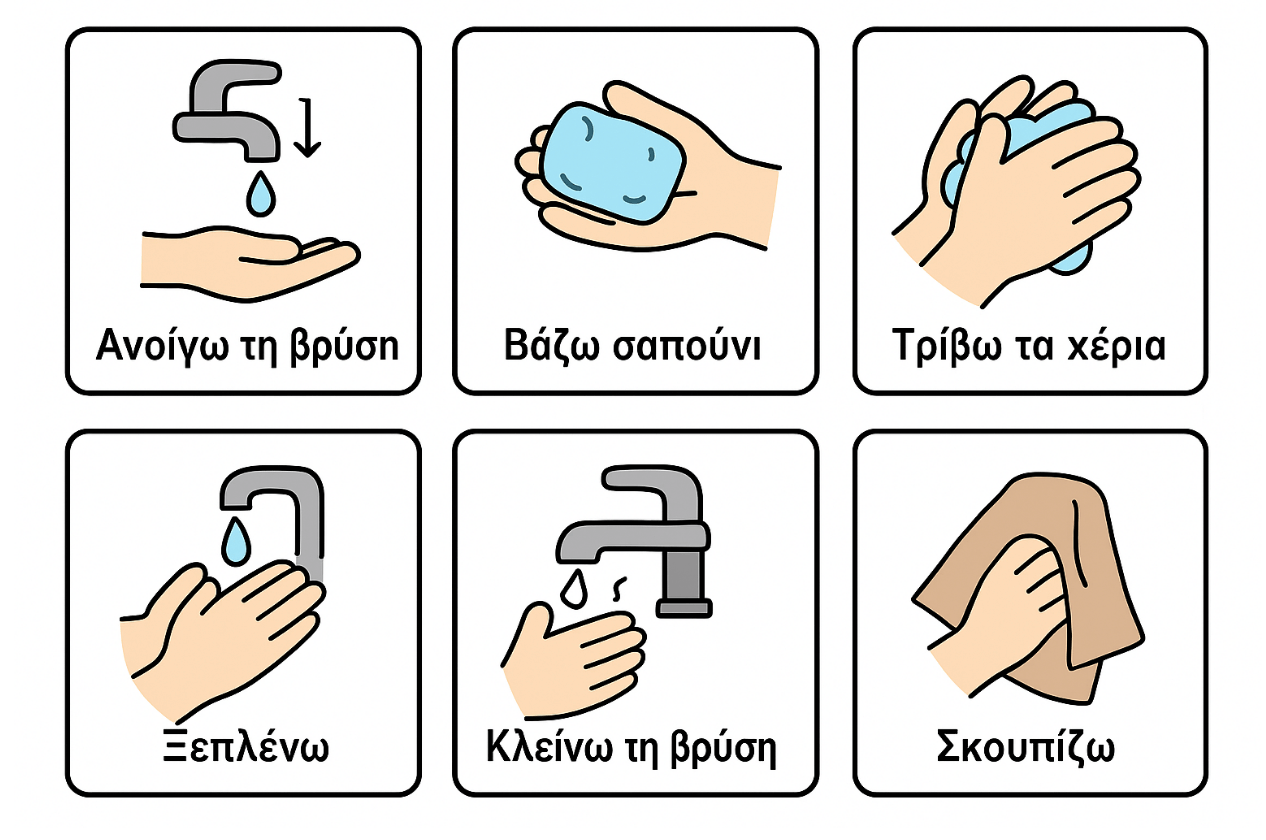
For example, the hand washing can be presented in a series of images: turn on the tap, put on soap, scrub hands, rinse, turn off the tap, wipe.
Visual instructions show the child what to do first, what to do second and how to know when it is finished. This develops autonomy, attention and concentration.
Role of parents in everyday life
Parents play a key role in the success of TEACCH, because the home is the place where routines are repeated every day.
With simple cards (as shown above) or small schedules, parents can organise daily activities such as dressing, school reading, play or bedtime routines.
No complicated materials are needed, even photos of the child or objects from home are enough. When the child sees the same structure at home and at school, he or she feels safe.
This reduces tantrums and helps the child to gradually gain more control over his or her daily life.
Toilet training with TEACCH
Η toilet training is also a common anxiety for parents, which with the help of TEACCH can become a predictable and understandable process.
It creates a visual program with all the steps: flush clothes, sit on the toilet, wipe, flush, flush, flush, wash hands.
The programme is always placed in the same place (e.g. on the flush or on the bathroom door, etc.), so that the child can watch it whenever he/she wants.
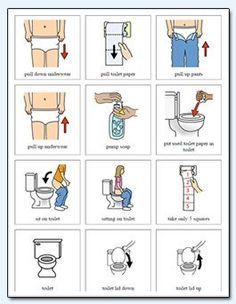
In addition, we keep a consistent routine, with a fixed schedule and times of toilet use, thus reducing verbal instructions.
Visual guidance helps the child to know what's next and gradually gain autonomy. The process becomes calmer and less stressful for the whole family.
At Our centre in Peristeri the occupational therapists in cooperation always with the parents, they plan individualised intervention programmes for toilet training always aiming at the maximum autonomy of each child
TEACCH and Other Systems (ABA, PECS, Makaton)
How it can be combined with other models
The TEACCH method can be easily combined with other therapeutic approaches, as it does not conflict with them but works in a supportive way.
For example, it can enhance the use of alternative methods of communication used in the speech therapy such as PECS or Makaton, providing the child with a clearly organised framework where images are more easily used.
It can also be used in parallel with social stories, sensory programmes or developmental methods such as DIR/Floortime or the Intensive Interaction, which focuses on relationship building and communication through joint attention and play.
TEACCH does not replace other interventions; it supports them, helping the child to better understand what will happen, where it will happen and in what order.
Comparative advantages and approaches
Every child is different, with their own needs, abilities and pace. That is why it is not useful to be dogmatic or to follow only one model of intervention.
The therapeutic community now supports holistic approaches as children benefit more from the combination and variety of activities instead of single methods.
TEACCH targets structure, visual organisation and autonomy, and combined with other approaches that may be more tailored to social interaction, language development or behaviour management, can bring the most desirable outcome for each child.
What matters is the healer be trained and have the ability to combine the methods for the best prognosis of the child.
Cooperation between professionals and family
The collaboration between professionals and family is crucial. When everyone uses the same visual aids and routines, the child feels safe and stable.
The parent structures the child's environment based on the therapist's instructions. Receives and uses materials designed with pictures, lists or objects.
After in-therapy training, the parent uses the child's individualised programme at home as well as in external settings (e.g. playground, supermarket, swimming pool, etc.).
Seminars and Training in the TEACCH Method in Greece
Where training and certification is offered
In Greece there are several seminars around the TEACCH method, either by private special education centres or by organisations working with certified trainers.
The training usually includes a detailed presentation of structured teaching, examples of routines, ways of organising the space and practical exercises for creating visual programmes.
Cost and duration of seminars
The seminars can be short (1-2 days) or longer, depending on the level of specialisation. Most programmes offer a certificate of attendance, useful for those working with children in autistic spectrum. Usually the cost of the seminars ranges from 500e to 700e.
Professional application
TEACCH knowledge helps professionals and parents to implement common strategies at home, at school or in the therapeutic context, creating a stable and organised environment that actively supports the child's daily life.
The use of the method has excellent results both in children on the autistic spectrum and in children with all kinds of neurodevelopmental disorders.
Conclusions
Why TEACCH is worth knowing
The TEACCH method offers a clear and practical way to help the child organise his/her daily life and gain autonomy.
With visual routines, structured steps and a steady schedule, the child learns to better understand the world around them and feel secure in transitions and changes.
TEACCH does not require special equipment or complicated techniques; instead, it can be easily implemented at home and at school, adapting to the child's actual needs.
TEACCH is worth knowing as it is one of the most practical and reliable approaches for children with ASD.
The importance of tailored education for people with ASD
Any child on the autism spectrum is unique, with its own potential, its own learning rate and its own personality. That is why the adapted education is essential: it allows the child to participate in learning in a way that matches the way he or she thinks and processes information.
Methods such as TEACCH help to reduce barriers, increase autonomy and enhance communication.
When education is based on the child's strengths, learning becomes more effective and everyday life smoother, both for the child and the family.