
Stages of Speech Development
Up to 12 months
- The baby reacts to sounds
- It has eye contact
- He smiles when spoken to
- Responds to his name
- Turns towards the source of the sound
- Understands “yes” and “no”
- Has basic vocabulary (dad. Mum, ball...)
From 1-2 years (children's speech onset)
- His expressive vocabulary has 20-50 words
- His perceptual vocabulary has about 300 words
- Uses simple 2-3 word sentences
From 2-3 years old
- Makes 4-5 word sentences
- Uses plural, prepositions, pronouns and articles
From 3-4 years old
- Answers all kinds of questions
- His speech is closer to that of adults, in terms of grammar and syntax
- He recounts his experiences
From 4-5 years old
- Can pronounce almost all the sounds of the Greek language
- The vocabulary reaches 1500 words
- Can change the tone and speed of speech
- Uses subordinate clauses
From 5-6 years old
- It has conquered all phonemes and the complexes containing them
- It has completely cleared the speech
- Can have a dialogue almost like an adult
Special Cases
Speech to bilingual children.
Speech in bilingual children is a special case in which the acquisition of the speech stage is not assessed in the same way. The younger the child, the easier it will be to develop bilingualism (ideally up to 3 years of life).
Many children, while understanding both parents' languages, usually choose to express themselves in one of them. In a speech delayed bilingualism can potentially slow down the development of language skills.
This is why it is recommended that communication should be in one language, especially the language used in the place of residence.
Each case is individualised because many factors are involved, but it is advisable to take into account what the dominant language is in the home, how well the parents speak the language of the place of residence and at what age the child comes into contact with the second language.
Speech development in children with autism.
Η speech development in children with autism depends on the severity of the disorder, the inclusion of the child in an early intervention programme and the involvement of parents in the treatment protocol.
However, there are also factors that can impair or facilitate speech such as motivation to communicate, possible oral coordination difficulties and the child's overall clinical picture.
Alternative communication programmes or visualised intervention methods are recommended to enhance speech development (PECS, go talk now, teacch).
Concerns about delay:
“2 years old does not speak”
Concerns about speech delay at the age of 2 years are often exaggerated because most children have their own pace of development.
It is important to assess the child's general communication and not just speech. If the speech delay at 2 years of age only concerns expression then it is advisable to wait until the 3rd year of life or integration into the school setting.
But if a 2-year-old child does not turn to his name, has obsessive interests, avoids looking into the eyes or does not point with the index finger, we should contact a specialist.
“3 year old does not speak clearly”
We are worried when the child 3 years old does fixed joint errors i.e. when he consistently replaces one letter with another (instead of foot he says pavi), when he makes simplifications (e.g. house, pitti), or vowel drops (instead of potato, pata).
We go to the speech therapist when, for example, he confuses “b“ with “d” or when he replaces many phonemes with one letter (e.g. instead of “the child is taking a bath” he says "ko pecaki kaki bakio")
Speech Disorders and Problems

Arthritis disorders
Difficulties with phonemes such as “r”, “l” and “i”.
The joint disorders relate to difficulty in producing certain phonemes such as “r”, “l”, “i” or another. These difficulties may be due to age, anatomical anomalies or limited mobility of the articulations (tongue, lips, cheeks, palate, etc.).
Each group of phonemes is expected at a specific age e.g. “p, b, m” and “k, g, c” are acquired by the age of 2.6-3 years, “b, d, h” by 3-3.6 years, “f, g, “d, i” by 4-4.6 years and ”s, r” by 5-5.6 years.
Common mistakes such as confusing “i” with “f”.
Quite often the replacement of “i” with “f” occurs (e.g. “I want” → “I bring”, “b” with “d” (e.g. “boro” → “gift”) or “r” with “l” (e.g. loda → roda). Many articulatory errors are cute in children however if they do not correct themselves at the ages mentioned above we need to refer to the speech therapist.
Dysarthria
What it is and how it affects speech.
Dysarthria is a disorder in the motor function of the joints due to damage to the peripheral or central nervous system. It affects the muscle tone of the orofacial muscles, the quality of breathing, joint clarity, voice tone or speech flow.
Types of dysarthria (e.g. hyperactive, lax).
Hyperkinetic dysarthria is characterised by a harsh voice, nasality, slow speech rate, labored breathing and difficulty in breathing in/out. On the other hand, relaxed/hypotonic dysarthria is characterised by short sentences, difficulty in phonation (“voice volume and clarity, prosody (“voice colour”)) and resonance (the persistence of sound after it has been produced).
Pseudism:
What is pseudism and why it occurs.
By the term “pseudism” we refer to the disorder of articulation of the sibilant phonemes “s”, “z”, “z”, “x”, “ps”, “ch”, "j". The reasons for this difficulty are as follows:
- gaps between the teeth (chasmodontia)
- poor occlusion of upper and lower teeth
- prolonged finger or pacifier feeding
- tooth preparation
Types of illusion (e.g. in “s” or “s”).
The most common species is the interdental sigmatism, in which “s” is produced as “i”, followed by oblique sigmatism, in which the person pronounces “s” for “x”. For example, “Today I'm going to the cinema” or ‘Today I'm going to the cinema“.
How it is treated.
The rehabilitation of this disorder depends on the cause of the phoneme alteration. Often, treatment by an orthodontic specialist may be needed when due to a maxillo-dental difficulty or speech therapy to strengthen the orofacial muscles and for correct positioning of the articulations.
Lateral sigmatism usually recovers in a longer period of time. An important factor is the age of the child at which intervention is started because the older the child is, the more established the difficulty.
When Should We Be Worried

Signs of speech delay.
Based on the chronological age of the child, the level of speech or speech delay is assessed each time. That is, a 12-month-old child who has not yet spoken his or her first words as expected for the average child of the same age does not mean that he or she has a speech delay.
Many children say their first words at 15 or 16 months. As well, most children make sentences at age 2, while others make sentences at age 3, so the delay observed at 2 was made up for afterwards.
However, when a 3 year old child has not said any words then we can claim that he/she has a speech delay because he/she has passed two developmental milestones of speech without a positive result.
In any case, speech delay must be taken into account with the other developmental areas, communication and perception of the child.
When to see a speech therapist
We need to visit speech therapist when the child faces significant difficulties in articulation, phonology, pragmatics, syntax, phonetics, phonetics, and contact and socialisation. In some cases, these difficulties may be related to Specific Language Disorder.
The most common thing is to go to the speech therapist after visiting the Child psychiatrist, the Developmental Specialist or the Paediatric Neurologist. We can also visit him on our own initiative or at the encouragement of the nursery teacher/teacher or paediatrician. If you would like to know more about the procedure, you can read more about the Child Psychiatric Examination.
Sudden difficulty in speaking and what it can mean.
In children, a sudden difficulty in speaking may be due to developmental, neurological or emotional factors. For example, some children started talking and suddenly lost this skill.
This may be an indication that the child is in the autistic spectrum. Some children may also experience sudden stuttering, i.e. intermittent speech with blocking and repetition of syllables. This may be due to heredity or psychological factors.
Finally, some children have speech difficulties after damage to the central nervous system (seizures, viral infections, strokes, brain injuries).
Speech and Language Therapy and Exercises
When does a child need speech therapy
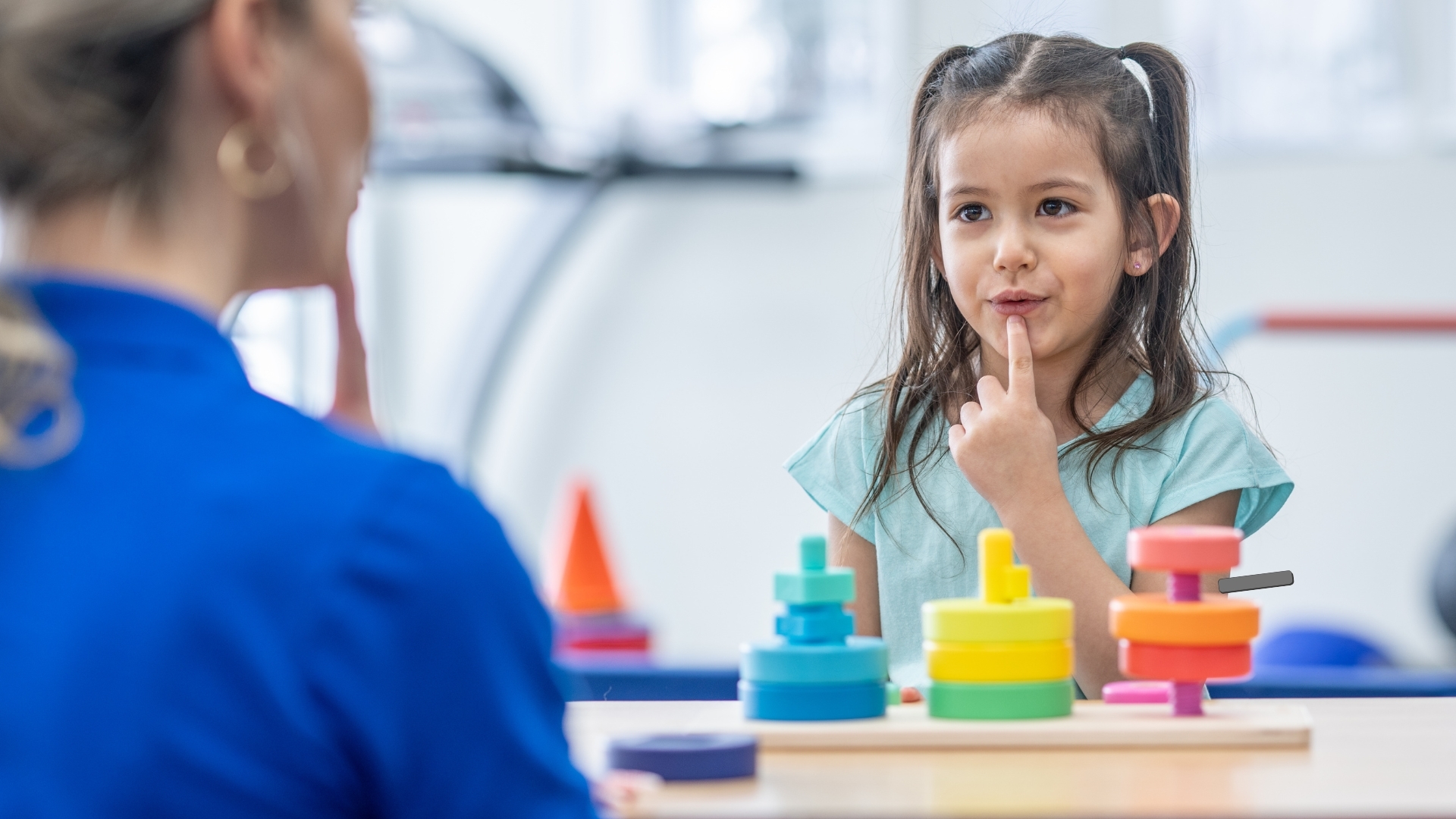
A child needs speech therapy when they have difficulties in communicating, speaking, articulating, understanding or expressing language.
More specifically, if you notice that he is not speaking clearly, has difficulty conveying information, becomes isolated, does not play functionally with his toys or gets lost in his thinking and cannot maintain a dialogue properly then it is advisable to visit the speech and language therapist.
Exercises for different ages
For children 2 years old
- Play with the child by naming with a few simple words what you are doing together (e.g. “the plane is flying high”, “the baby is sleeping”, the dog is walking”, etc.
- Play games that imitate animal sounds (e.g., “bark-bark”, “meow-meow”).
- Encourage naming simple objects (e.g., ball, cat).
- Ask the child to show you pictures from fairy tales
- start a little song and wait for the child to continue
Exercises for a clean joint.
- Use a mirror so the child can see how his or her mouth moves
- Use straw for blowing or bubbles for muscle strengthening.
Special Exercises for Voices
For “r”: words and exercises
- For “r”: create games with repetitions of words such as “sew”, “stream”, “ruby”. Strengthen the orofacial muscles with tongue-raising movements.
For “l”: words with many “l”
- For “l”: work with the child in front of a mirror, playing and making funny faces while holding up the tongue. Use words like “lala”, “lamp”, “flower”. Create repetition games.
For “i”: distinction from “f”.
- For “i”: compare it with “f” using words such as “want” and “fello” to help the child identify the correct word. Ask the child to lightly touch the tongue to the teeth and repeat words such as “want”, “aunt”, “bush”.
Tips for Parents

How to help your child speak more clearly
In order for your child to speak clearly and with more fluency, you must first of all you discuss with him about your own daily life and then be interested in him telling you about his.
It is good to tell him the news of your day, talk about your feelings, answer his questions, play games with him and have a dialogue. Through play we provide the child with pleasant experiences and the opportunity to further develop his speech.
During playtime we share with joy, knowledge, pleasant emotions, enhancing the child's motivation to correct his speech. In this condition he is more receptive to the observations, repetitions and imitation of the adult.
Finally, he needs:
- Speak slowly and clearly, giving the child time to respond.
- Play games such as mime or reading picture books.
- Reinforce speech through songs and simple rhymes.
- Do not constantly correct the child, but show the correct example by repeating the word correctly.
- Create a positive atmosphere with praise for every effort.
- Minimise exposure to screens
Conclusion
Each child follows his or her own unique rate of development, which we should respect when it does not deviate significantly from the normally expected stages.
Η early intervention is primarily based on early assessment. The earlier the child's developmental difficulties are identified, the better the outcome of the child's treatment. Children who attend an early intervention programme, i.e. before 3 years of age, have a better rate of learning and better cognitive, communication and adaptive skills upon integration into school. If you want to learn more about the process, read more about Administration of Diagnostic Tests.
Parents, who know their child better than anyone else, have the most important role. It is good to create a safe environment with a stable schedule, rules and boundaries. They need to expose it to new environments, create opportunities to socialize and play together often.
Reward efforts and not stand on deficiencies but on strengths and talents. The key to everything is acceptance and love, which are the basis for a balanced development.